On this page
1. The problem
Most neighbourhood businesses in Saudi Arabia run on WhatsApp and Google Maps, not on websites:
- Customers find them on Maps, then message on WhatsApp — and the first message rarely says what they actually want, so every enquiry starts with the same questions.
- Their Google profile is often miscategorised or incomplete, and reviews arrive by chance, not by process.
- Generic agency pitches ("you need a website") don't land, because the owner can't picture the result or see what it changes.
The question: How do you show a small business owner, concretely and in their own terms, what going digital would change — before asking for a decision?
2. Approach: research first, then build in their identity
- Public-data audit. For each business: Google category, rating, review count and recency, compared with similar businesses within a 2–4 km radius.
- Gap → fix mapping. Every finding is paired with a specific fix ("Google lists you as a general contractor" → correct the category, services and photos).
- Sector-specific design. The same framework, adapted to how each sector actually sells.
- One shareable hub. All components behind one link, navigable on a phone, so the owner can explore it alone and forward it to a partner.
3. What each package contains
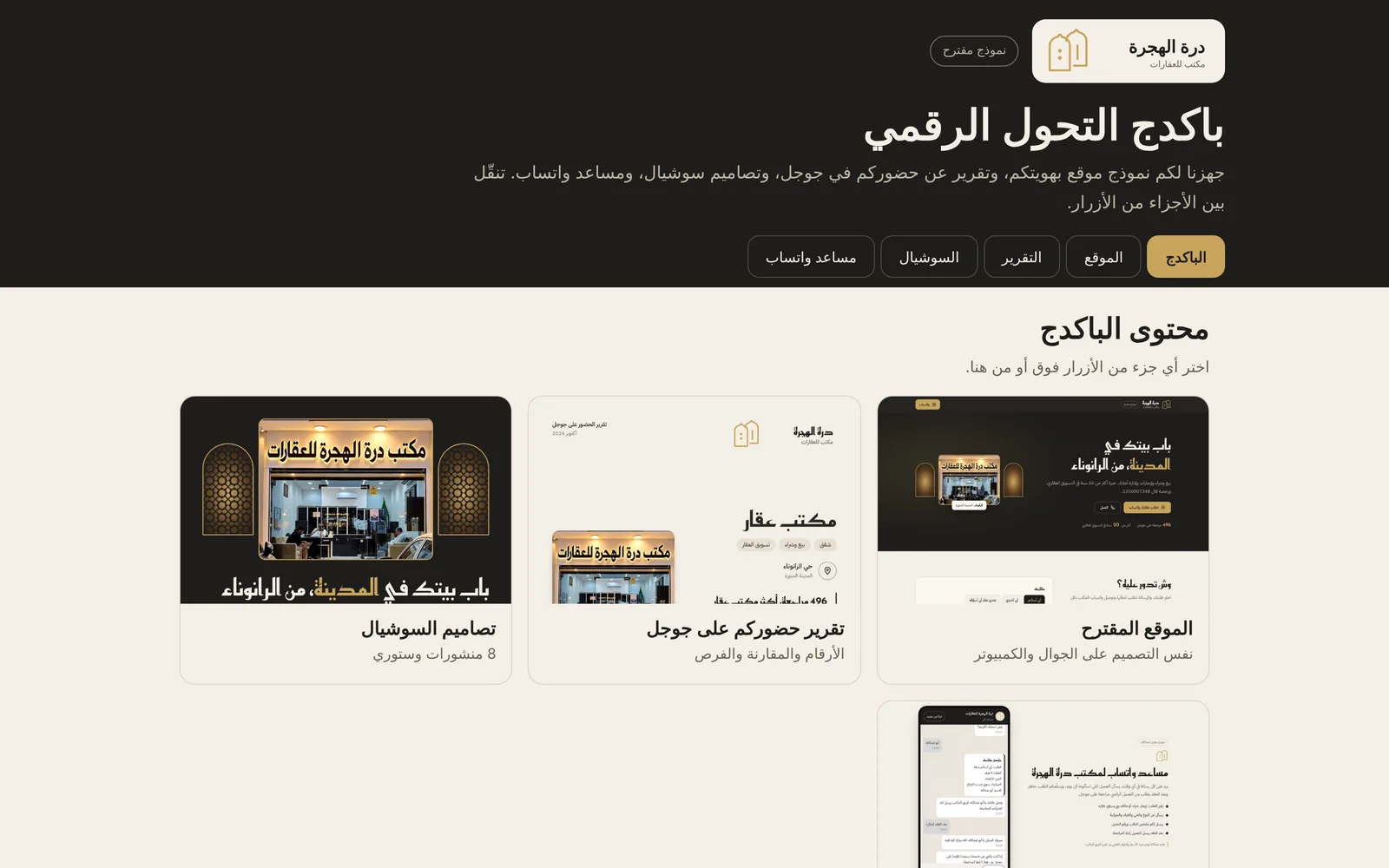
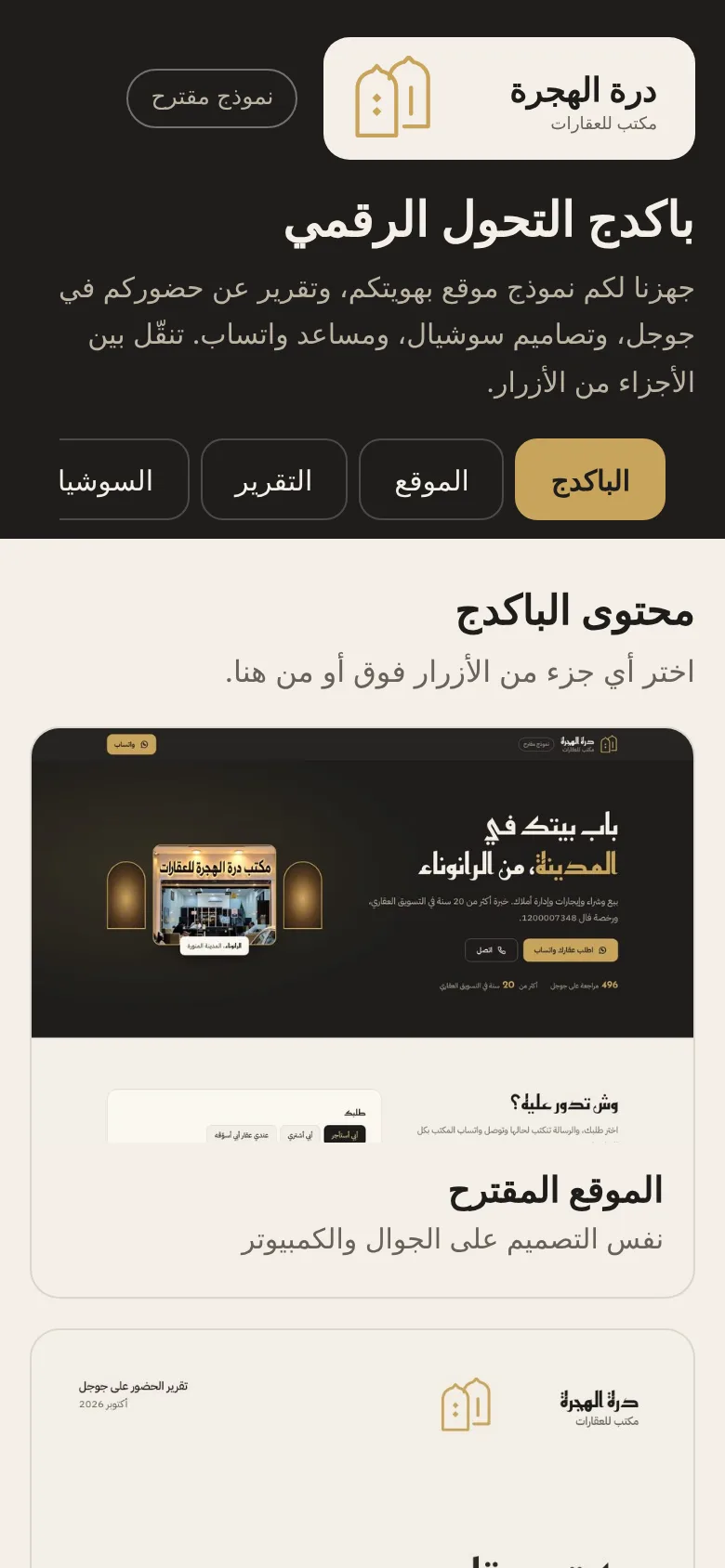
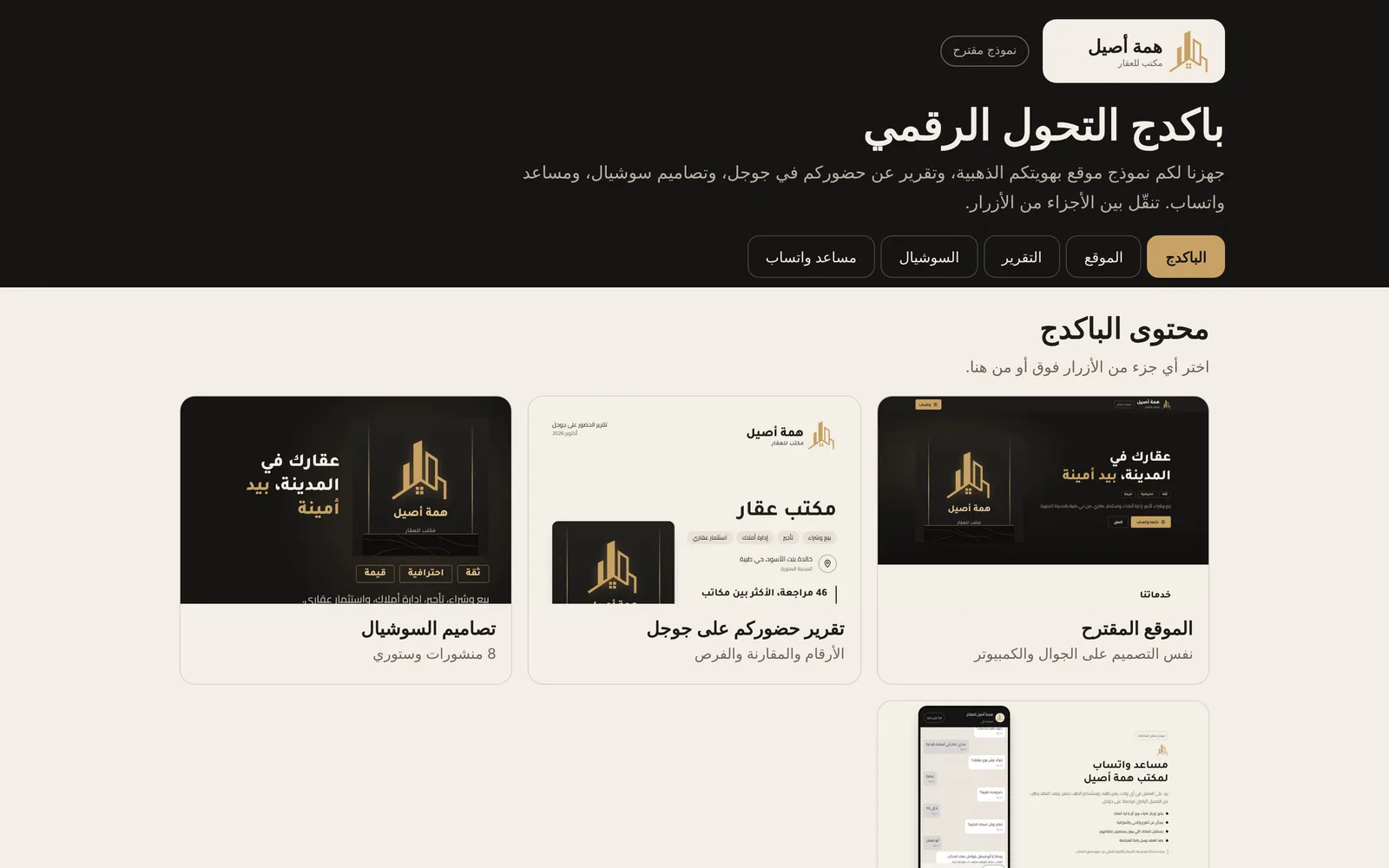
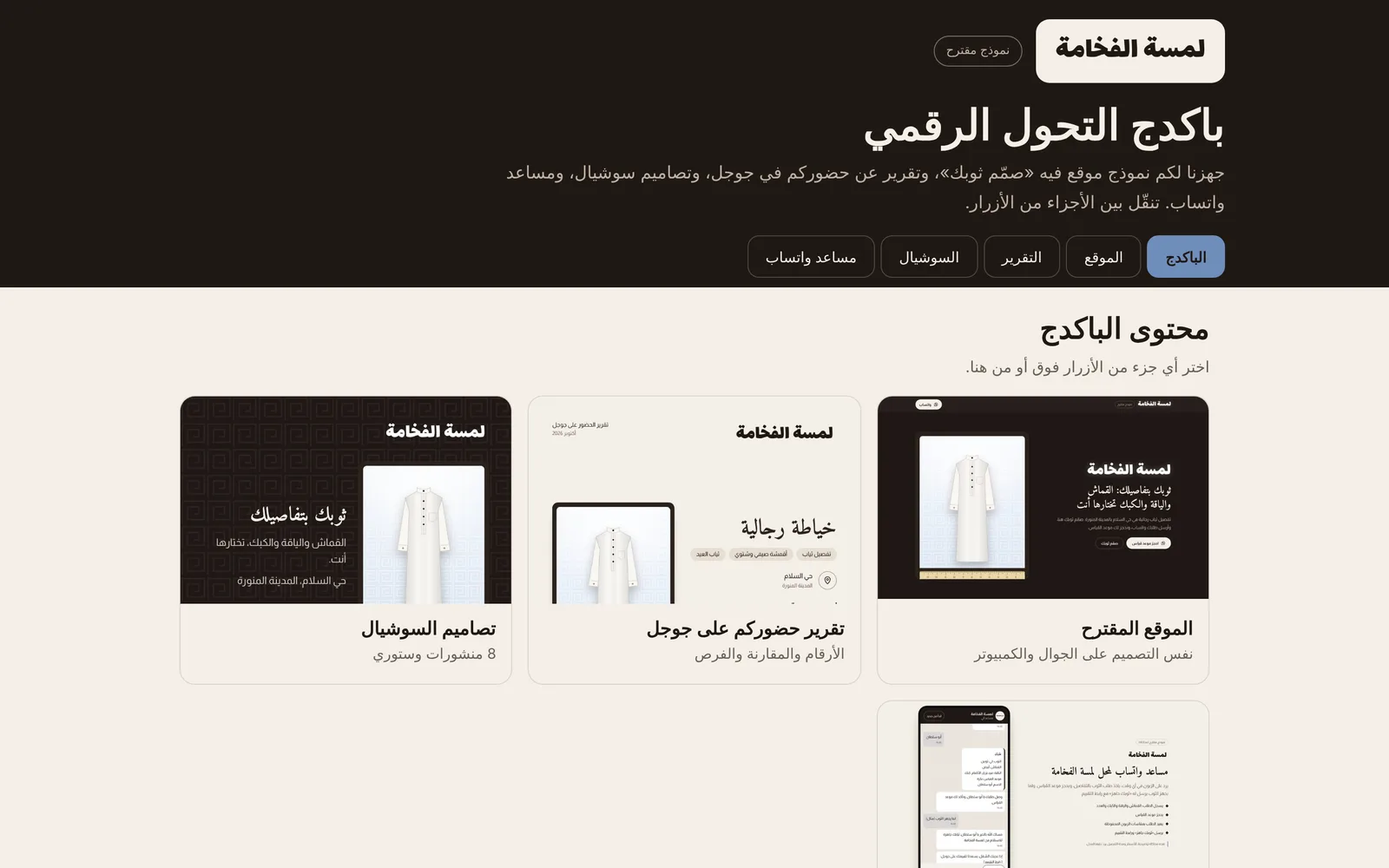
Proposed website — built around the WhatsApp message, not the homepage.
- Real estate: a request builder (rent / buy / list my property → type → rooms → district → budget) that composes a complete WhatsApp message for the office, so the first message is already a qualified lead.
- Tailoring: an interactive thobe designer (fabric colour, collar, sleeves, pocket, quantity) that previews the choice and sends it as an order; plus a booking flow for measurement appointments ahead of Ramadan and Eid peaks.
- Listing cards carry the advertiser's FAL licence number, ad licence number and expiry, in line with Saudi real estate advertising rules.
Google presence audit (report).
- Where the business ranks among nearby competitors by rating and review volume.
- What's holding it back today, and what changes after the fixes.
- A review trajectory showing how a review request after every closed deal moves the rating over time.
- Example insight: one office had the most reviews within 2 km (496) but the lowest rating among its peers (4.1). The issue wasn't visibility: reviews were arriving by chance rather than from satisfied customers. The fix is a review request sent automatically after each contract.
Social designs. 8 posts and stories per business in its identity — intro, services, rental and sale templates with licence fields, awareness posts, and stories that route to WhatsApp.
WhatsApp assistant (simulation). A conversation the owner can try as a customer:
- Greets and triages: rent, buy, list a property, or location.
- Asks only what the office asks every day: type, rooms, district, budget, name.
- Hands the team a structured summary.
- After the deal, sends the satisfied customer the Google review link — closing the loop with the audit.
4. Design decisions
- Show, don't pitch. A working preview in the client's identity replaces a slide that describes one.
- WhatsApp is the product. Every component ends in a better first message or a review request — the two things that actually move a local business.
- Data before design. The audit gives the owner a reason to act that is about their numbers, not a generic trend.
- Productized, not custom. One framework, adapted per sector and per business, so each new proposal starts from a proven structure.
- Local voice. Copy written in the Saudi dialect customers actually use.
5. Reflection
- The same structure adapted cleanly from real estate to tailoring, which suggests it generalises to most appointment- or enquiry-driven local businesses.
- Next: measure it — proposal-to-meeting rate, and for adopters, enquiries per week and review growth before vs after.
Skills shown
- Market Research
- Competitive Analysis
- Customer Journey
- Offer Design
- UX
- Conversational Design
- WhatsApp Automation
- Local SEO
- AI-Assisted Development
Open the work
The actual artifacts, not screenshots of them.