On this page
1. The problem
Most EdTech offerings for children are generic and trend-driven: students learn what is popular, not what fits their abilities, and parents pay for courses with no measurable outcome. EDUUU's proposition is live, personalised programming and AI learning paths for ages 9–17, with visible progress for parents.
2. Approach
| Stage | What I did | Artifact |
|---|---|---|
| Initiation | Defined problem, objectives, constraints, methodology | Project Charter |
| Strategy analysis | Current state → strengths & weaknesses → alternatives (B2C / B2B / hybrid) → recommendation: launch B2C to parents | Strategy Document |
| Planning | Techniques, timeline and risks for elicitation | Requirements Work Plan |
| Scope | In/out of scope for phase 1 (mobile app, B2B, marketplace and AI recommendations deferred) | Scope diagram |
| Stakeholders | 6 groups on a Power/Interest matrix with needs, concerns and strategy | Stakeholder map & register |
| Elicitation | Sponsor interview guide (10 questions) and parent survey (10 questions) validating personalisation, project-based learning, progress tracking and price sensitivity | Interview guide · Survey design |
| Requirements | Functional and non-functional requirements prioritised with MoSCoW, organised as Jira epics | Requirements list |
| Modeling | Use case diagram (4 actors, 16 use cases) · BPMN registration process (Student / System / Payment gateway) · Payment flowchart | Diagrams |
| Documentation | BRD (11 sections) and a traceability matrix linking every requirement to a module and test cases | BRD · RTM |
| Analytics | 3-page Power BI dashboard on a 5-table pilot dataset (Overview · Revenue · Students) | Dashboard |
3. Requirements highlights
- Must have: secure registration, live interactive sessions, personalised learning paths, age-appropriate curriculum, payments & subscriptions, progress tracking, parent dashboard, project submission, engagement & satisfaction tracking.
- Should have: student portfolio, certificates, content refresh every 6 months, career-readiness track after one year.
- Non-functional: 99.5% uptime, Arabic & English, desktop and mobile web, pages under 3 seconds, encrypted user data.
- Traceability: every FR and NFR maps to a module and at least one test case in the RTM.
4. What the pilot data said
Simulated pilot dataset: 200 students · 10 courses · 408 enrollments · 234 satisfaction surveys (Jan–May 2025).
| Metric | Value |
|---|---|
| Gross bookings | 279K EGP |
| Collected revenue (paid only) | 173K EGP — 62% of bookings |
| Pending payments | 82 enrollments |
| Refunds | 75 enrollments — 18% refund rate |
| Enrollment status | 132 completed · 185 in progress · 91 started |
| Overall satisfaction | 4.25 / 5 (target 4.5) |
| Lowest-rated dimension | Platform 4.0 (vs instructors 4.27, content 4.23) |
| Would recommend | 78% |
| Most-used payment method | Fawry (23% of bookings) |
| Highest refund rate | Python for Kids — 30% (vs 8–9% for Robotics and Python Advanced) |
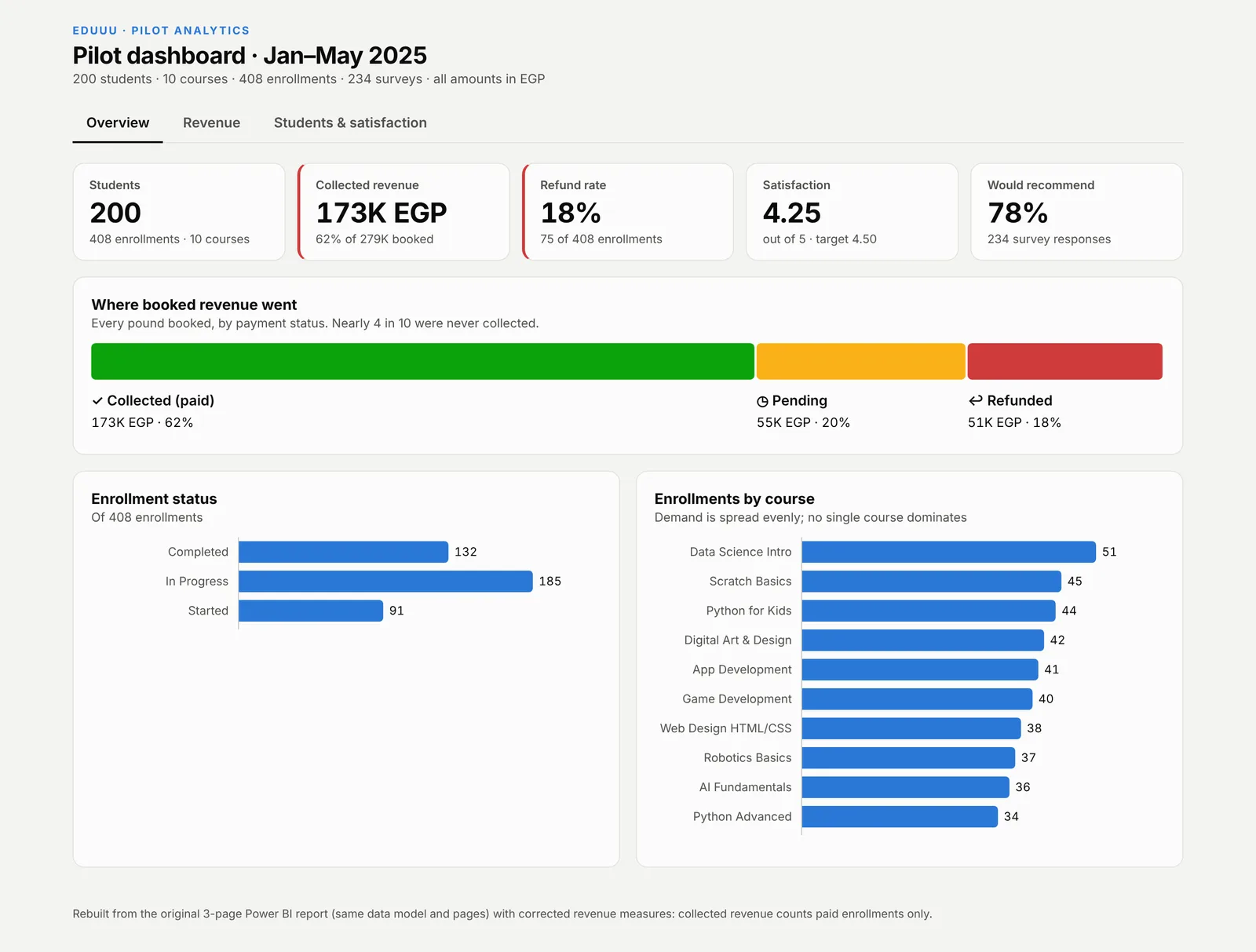
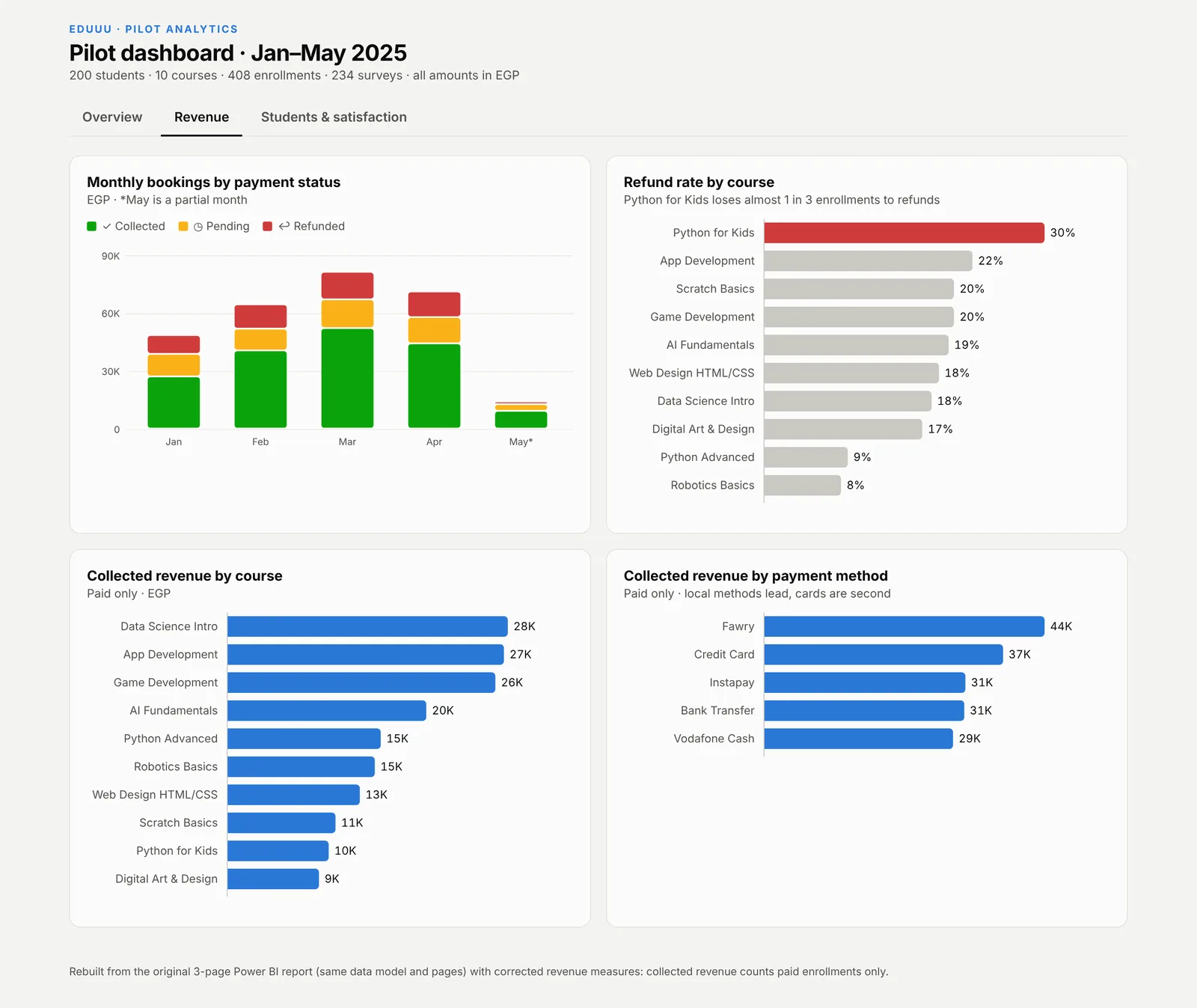
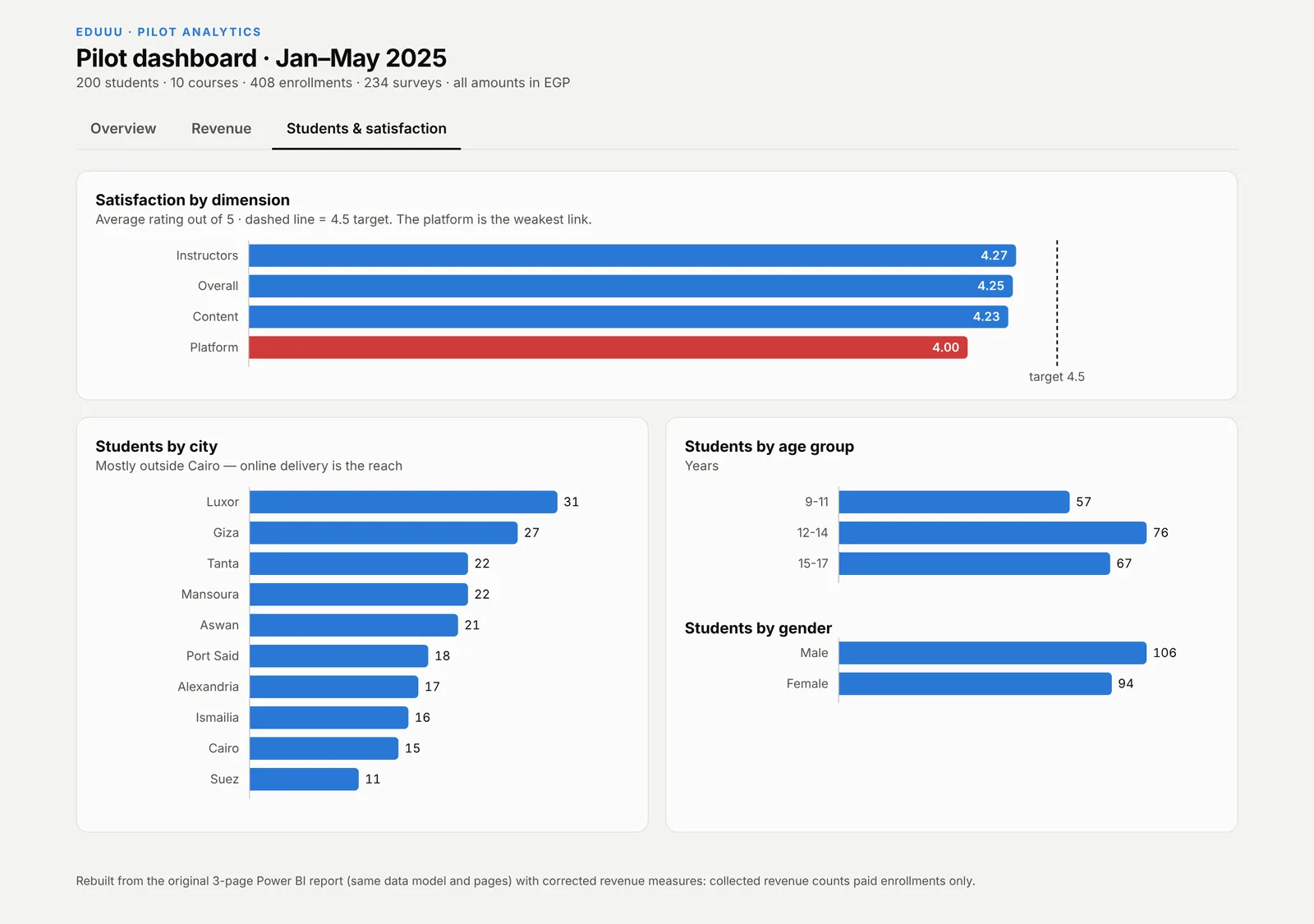
Dashboard pages rebuilt for the portfolio from the original Power BI report — same data model and pages, with the revenue measure corrected to count paid enrollments only. Interactive version: eduuu-dashboard.html.
Insights → recommendations
- Revenue leakage is the first problem, not acquisition. Nearly 4 in 10 booked pounds were never collected. Recommend: investigate refund reasons, add payment reminders for pending enrollments, and consider a trial session before payment.
- The platform, not the teaching, is pulling satisfaction below target. Instructor and content scores are close to target; platform experience is lowest. Recommend prioritising UX fixes before adding new courses.
- Refunds concentrate in the entry course. Python for Kids — the youngest learners' first course — loses almost 1 in 3 enrollments to refunds. Recommend: interview those parents, review pacing and age fit, and test a free first session for this course before anything else.
- Fawry and Instapay matter. Local cash-based and instant methods lead; the payment module must support them from day one, not just cards.
5. Key decisions
- B2C first — parents decide and pay; B2B and marketplace deferred until the core proposition is proven.
- Parent visibility as a Must — parents are high power and high interest; progress they can see is what renews subscriptions.
- Mobile app deferred — responsive web covers mobile users at a fraction of the cost within a $50K, 6-month plan.
6. Reflection
- Gross bookings can hide the real picture. The first version of the dashboard summed every booking as revenue; correcting the measure to paid-only changed the headline from 279K to 173K and moved revenue leakage to the top of the list.
- Elicitation was simulated (interview guide and survey design rather than real responses); the next step is running the parent survey for real and comparing its results with the assumptions in the BRD.
- The live site validates the proposition as a one-to-one tutoring offer; the BRD describes the full platform it would grow into.
Skills shown
- Strategy Analysis
- Stakeholder Analysis
- Elicitation
- MoSCoW
- Use Cases
- BPMN
- BRD
- RTM
- Jira
- Power BI
- DAX
Open the work
The actual artifacts, not screenshots of them.